

Topic: Education
Ten careers to watch in the AI era: what should students prepare for now?
The AI era needs more than the people who build AI. Ten careers worth a student's attention, and why trying a small project in a field you already like beats picking a job title first.
As AI gets better, which jobs will disappear?
It is a question students and parents ask us often when we teach.
And AI really is taking over work people used to do, changing how many jobs get done.
The World Economic Forum projects that by 2030, job creation and destruction will amount to 22% of today’s jobs, and that 39% of the skills workers hold today will be transformed or go out of date.
But look at the hiring market and the opposite change is happening at the same time.
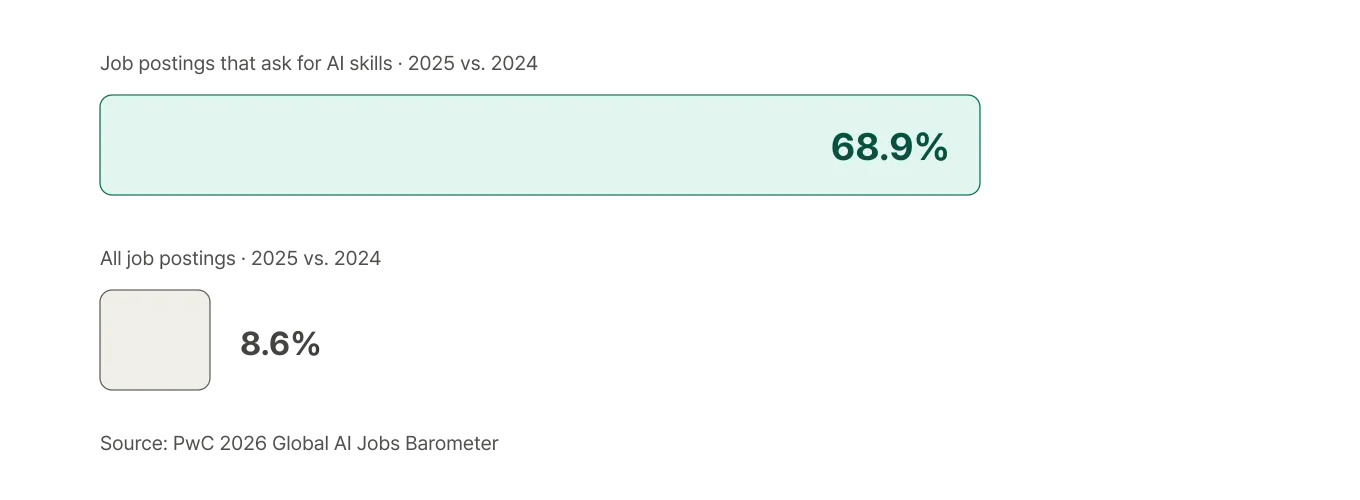
According to PwC’s 2026 global AI jobs report, postings that ask for AI skills rose 68.9% in 2025 compared with the year before.
Over the same period, job postings as a whole grew 8.6%.
Postings that ask for AI skills grew roughly eight times faster than the hiring market overall.
So does every student now have to become an AI developer?
Not quite.
Look closely at the jobs of the AI era and a few directions come into view.
Some people build AI itself,
some connect AI to real problems and products,
and some make sure AI is used safely.
And the change that will reach the most people is probably a different one.
Bringing AI into a field you already know well.
Someone who knows marketing, using AI.
Someone who knows medicine, using AI.
Someone who knows education, using AI.
Someone who knows sports, using AI.
Here are ten careers and roles worth watching for students preparing for the AI era.
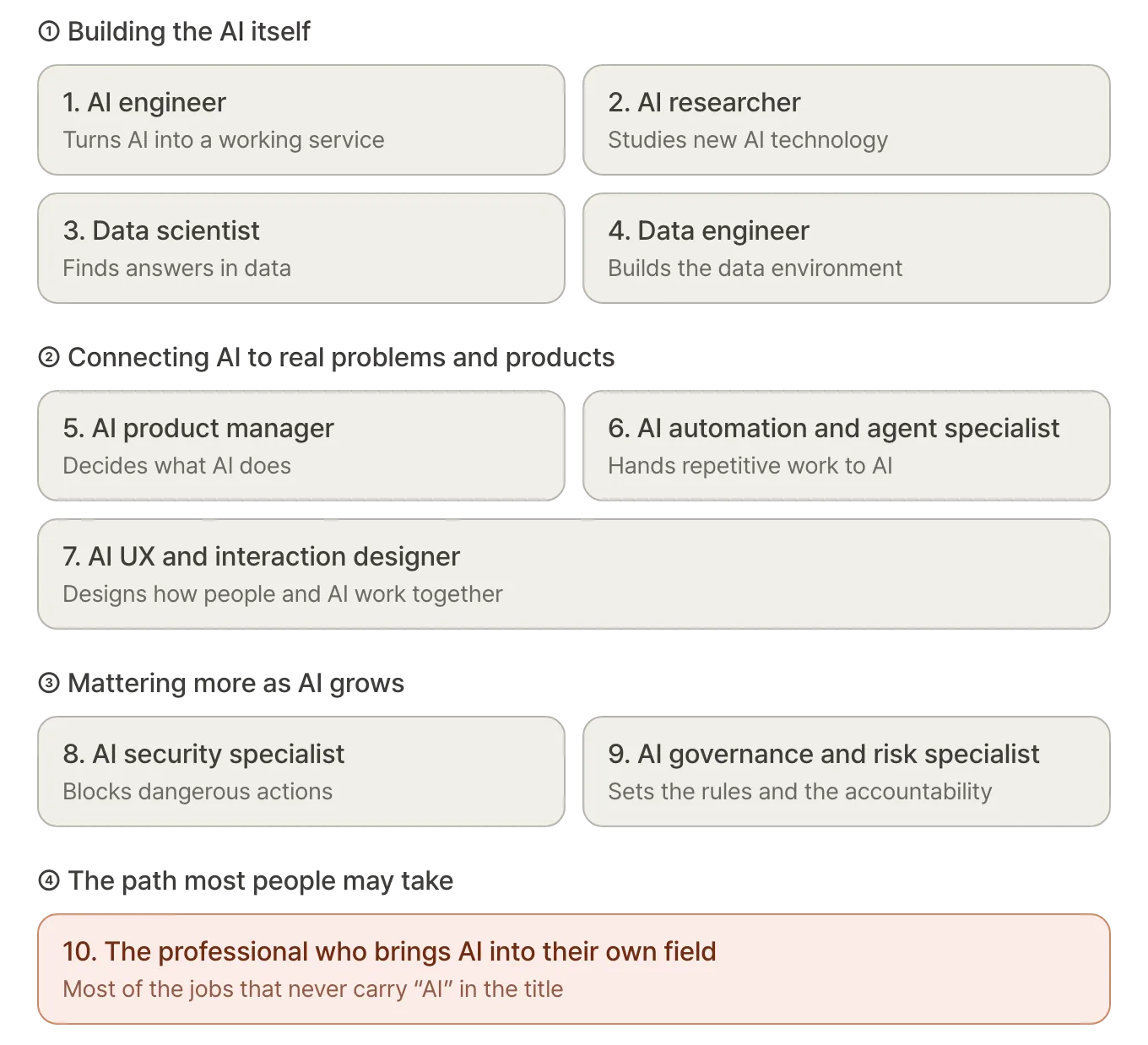
① Building the AI itself
1. AI engineer
The person who turns AI into a working service
Asking ChatGPT a question is easy.
Putting an AI like ChatGPT inside a real service and making it work properly is far harder.
Say you want to build an AI assistant for an online store.
The AI has to be able to read the company’s product information,
understand what the customer is asking,
find what it needs,
and avoid inventing information that doesn’t exist.
It also has to connect to the website, the app, and the database you already run.
The person who actually builds all of that is the AI engineer.
Lately AI has been going into more than chatbots — search, recommendations, image generation, voice services, AI agents — and the ground an AI engineer covers has widened with it.
The bar is high, though.
You have to learn a programming language like Python, plus data handling, APIs, and the fundamentals of machine learning and AI.
It suits students who like building things with code and enjoy working through a problem logically.
You don’t have to start by building an enormous model. Building a small service on top of an existing AI is enough of a beginning.
2. AI researcher
The person who studies AI itself
If an AI engineer is closer to putting existing AI to work in real services,
an AI researcher goes one layer deeper.
They look for new ways to make AI learn better, judge more accurately, and run more efficiently.
They might study new model architectures,
find ways for AI to learn from less data,
or work on AI that understands images, language, or robots better.
The technology behind generative AI like ChatGPT advances through exactly this kind of research.
AI research often demands a deep grounding in mathematics and computer science.
Among these ten paths, its academic bar is one of the highest.
But for a student who thinks
“I’m more curious about why AI works than about using it.”
“I want to build new algorithms and techniques myself.”
it can be a strong fit.
3. Data scientist
The person who finds answers inside data
Companies pile up a lot of data every day.
Who bought which product,
which ad brought people in,
which users stopped using the service,
when revenue was high — all of it is data.
A data scientist analyzes that data to find patterns, predict what is coming, and help people make better decisions.
They might forecast next month’s revenue,
find the customers most likely to leave,
or work out which products a customer will like.
The U.S. Bureau of Labor Statistics projects employment of data scientists to grow 33.5% between 2024 and 2034.
If you like math or statistics, and looking at numbers and asking
“Why did it come out this way?”
is your idea of fun, this is worth a look.
4. Data engineer
The person who prepares the data AI will use
In the AI era, something matters as much as the model.
The data.
However good the AI is, a mess of data makes good results hard to come by.
The catch is that real company data is nowhere near as tidy as you would imagine.
It is scattered across systems,
stored in different formats,
and salted with wrong values and duplicates.
A data engineer gathers and cleans that data into a shape AI and analysts can actually use.
Put simply,
if a data scientist is the person who analyzes the data, a data engineer is the person who builds the environment that makes analysis possible.
The more data AI needs, the more this role is likely to matter.
② Connecting AI to real problems and products
5. AI product manager
The person who decides what to ask AI to do
Building an AI product takes more than developers.
Someone has to ask first:
“What problem are we trying to solve?”
“What role should AI play in it?”
“How much do we hand to AI, and where does a person have to check?”
The person who works on that is the AI product manager, often called an AI PM.
Say you are building an AI study service for students.
The AI could recommend problems,
explain the ones they got wrong,
or read their study history and plan what comes next.
But stuffing in AI features does not make a good product.
The AI can give a wrong answer,
and it can misread what the student wanted.
So what matters for an AI PM is less knowing a lot of AI tools than
finding the user’s problem, and telling apart what AI is good at from what it is not.
It suits students who like coming up with new service ideas or noticing what frustrates people.
6. AI automation and agent specialist
The person who hands repetitive work to AI
Companies have far more repetitive work than you would expect.
Reading emails and sorting them by owner,
checking customer inquiries,
writing up what was said in a meeting,
pulling scattered material together into a report,
moving data from one program to another.
An automation specialist looks at that work and asks:
“Does a person really have to keep doing this over and over?”
When an inquiry arrives, an AI can understand it and route it to the right person automatically.
When a meeting ends, an AI can summarize it and lay out what needs doing.
Lately AI agents — which use several programs and tools themselves to carry work through multiple steps — have been improving quickly.
So what will matter is more than using AI well. It is
designing which work to hand to AI, and in what order.
One advantage of this field is that you can start with a small problem near you.
Finding a single repetitive task at school or in daily life and automating it already makes a good project.
7. AI UX and interaction designer
The person who makes people and AI work well together
Design has a different job to do in the AI era.
In a traditional app, people pressed buttons and picked from menus.
In an AI service, users ask in plain language, or talk with the AI until they get what they wanted.
Which raises new questions.
How do you show someone what to give the AI in the first place?
How do you show that the AI is not sure about its answer?
Should the AI ask permission before it acts?
When the AI gets something wrong, how do you make it easy to fix?
Designing an experience where people understand AI and use it comfortably is becoming a job of its own.
If you like design but are also drawn to technology,
or you enjoy watching how people actually use a product, this is worth a look.
The designer of the near future may do more than make screens beautiful.
They may be the person who designs how people and AI work together.
③ Mattering more as AI grows
8. AI security specialist
The person who keeps AI from doing something dangerous
The more AI can do, the more new risks appear.
Someone can craft an instruction that gets an AI with access to internal documents to hand over something it was never meant to show.
An AI can expose personal information or company secrets by mistake.
The risk grows once AI stops merely answering and starts
sending mail,
opening files,
editing data,
and using company systems directly.
So the role of the AI security specialist — who designs and manages how much information AI can see,
which actions it is allowed to take,
and how dangerous instructions get blocked — is becoming more important.
The U.S. Bureau of Labor Statistics projects employment of information security analysts overall to grow 28.5% between 2024 and 2034.
It suits students who like finding the holes in a computer system, or thinking through attack and defense.
9. AI governance and risk specialist
The person who sets the rules for how far AI can go
As AI grows more important, a question arrives alongside
“Can we build this AI?”
that matters just as much.
“Should we be using this AI?”
Say a company uses AI in its hiring process.
Someone has to check whether the AI judges certain applicants unfairly,
what data it was trained on,
who is accountable when it gets something wrong,
and whether personal information is properly protected.
In fields that weigh heavily on people’s lives — schools, hospitals, finance — those questions matter even more.
An AI governance and risk specialist
finds the risks that come with using AI,
writes the standards a company or institution has to meet,
and checks whether AI is being used responsibly.
For a student interested not only in technology but in law, ethics, policy, and social issues, this can be a new direction.
④ And the path most people may take
10. The professional who brings AI into their own field
The last one is not exactly a job title.
It is closer to how most jobs are about to change.
Someone who knows marketing, using AI.
Someone who knows accounting, using AI.
Someone who knows medicine, using AI.
Someone who knows design, using AI.
Someone who knows education, using AI.
Picture two marketers with the same job.
One searches competitors one at a time, organizes the material, and writes the ad copy by hand.
The other uses AI to research competitors,
analyze customer data,
generate dozens of ideas,
then judges which ones are good and develops them further.
Both are marketers.
But how they use AI can make their work look completely different.
LinkedIn’s 2026 labor market report likewise finds that in the U.S., jobs requiring AI literacy skills grew 70% year over year, and that digital and data literacy have become the baseline across technical and non-technical job functions alike.
The most common AI-related jobs ahead may not carry “AI” in the title at all.
Not an AI marketer, but a marketer who uses AI well.
Not an AI designer, but a designer who treats AI as a new tool.
Not an AI education specialist, but an education specialist who understands teaching deeply and uses AI.
In the end, rather than erasing every major and job, AI is closer to
changing how each person puts their own major to work.
So which career should students choose?
Look over the ten and a question follows naturally.
“So what am I supposed to choose?”
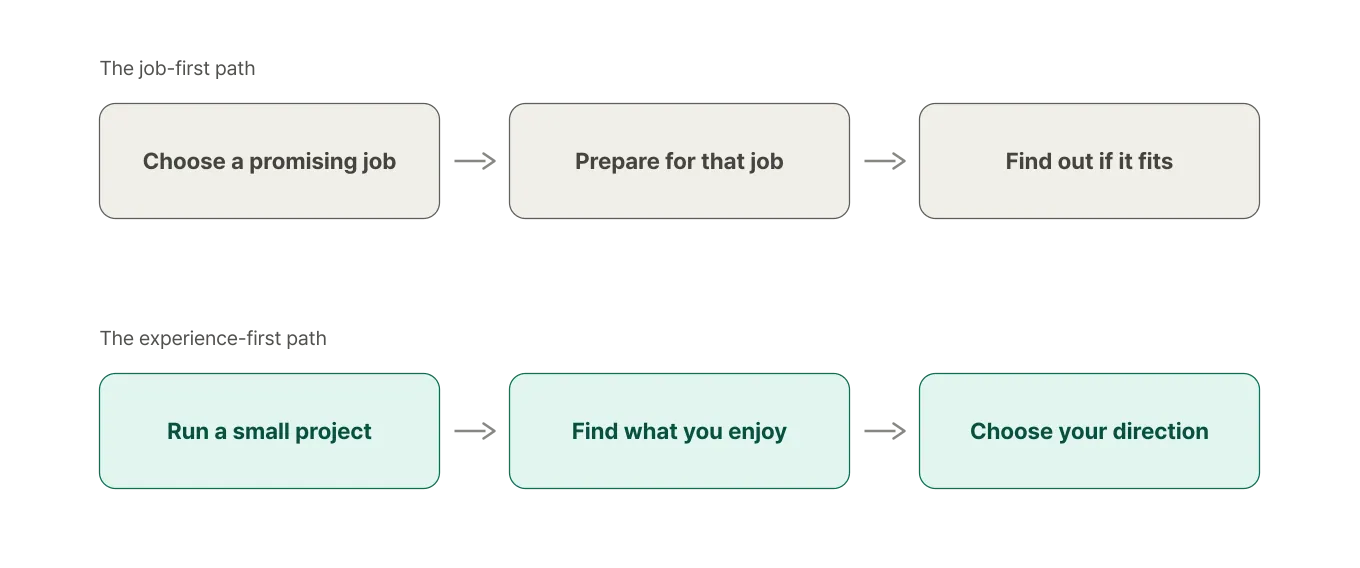
But what matters more for a student right now may not be picking one promising job quickly.
AI is changing far too fast.
The work inside today’s jobs may look very different in a few years,
and roles whose names are unfamiliar today may appear.
Memorizing the names of the jobs that are about to rise is not enough.
Look at the ten again and something important shows up.
Almost none of them work if AI is all you have.
An AI engineer has to understand what problem the service is solving.
A data scientist has to know what is worth analyzing.
An AI product manager has to find the user’s problem before the technology.
An automation specialist has to understand how the actual work runs.
An AI UX designer has to understand people.
An AI governance specialist has to think about the effect AI has on society.
And to use AI in your own field, what you need above all is an interest in that field, and an understanding of it.
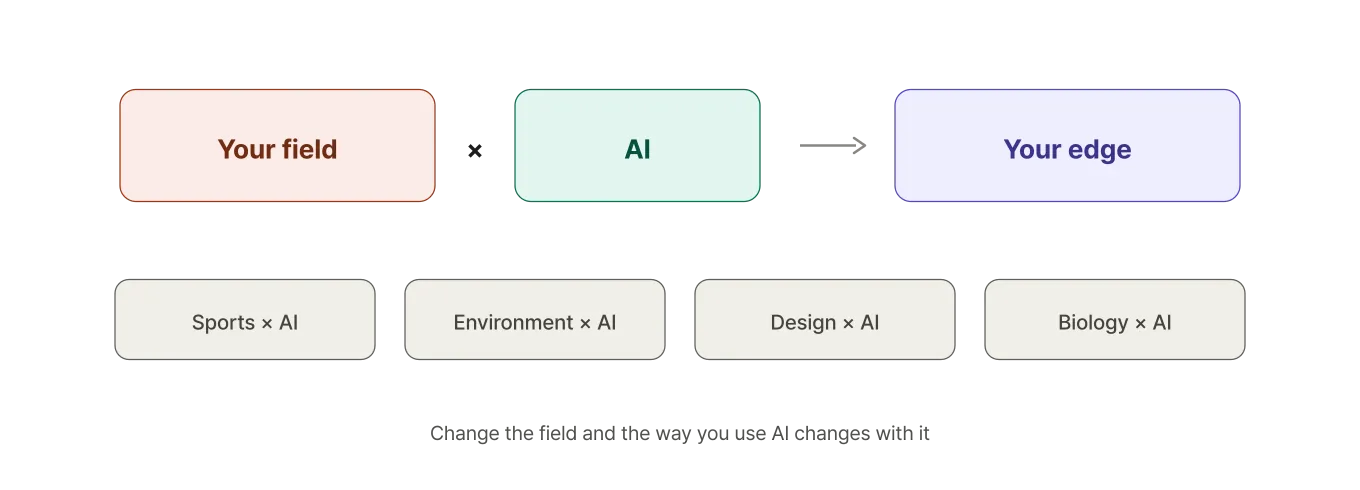
In the end, the edge in the AI era is more likely to come from
my field of interest × AI
than from
AI alone.
But you are still a student — how do you find “your field”?
Here is where it gets practical.
Telling a student
“Find the field you love and combine it with AI.”
is easy.
Deciding that field in advance is hard, though, when you haven’t had the chance to try much yet.
Whether medicine is interesting,
whether you love sports,
whether you want to solve environmental problems,
whether data analysis suits you,
whether building a product is fun —
there is no way to know before you try.
So we think doing a small project in a field you are curious about is a better way to explore than deciding on a job first.
Find one problem in a field you care about,
work out how AI could solve it,
use data to check whether the problem is really there,
and, at the end, build something that actually runs.
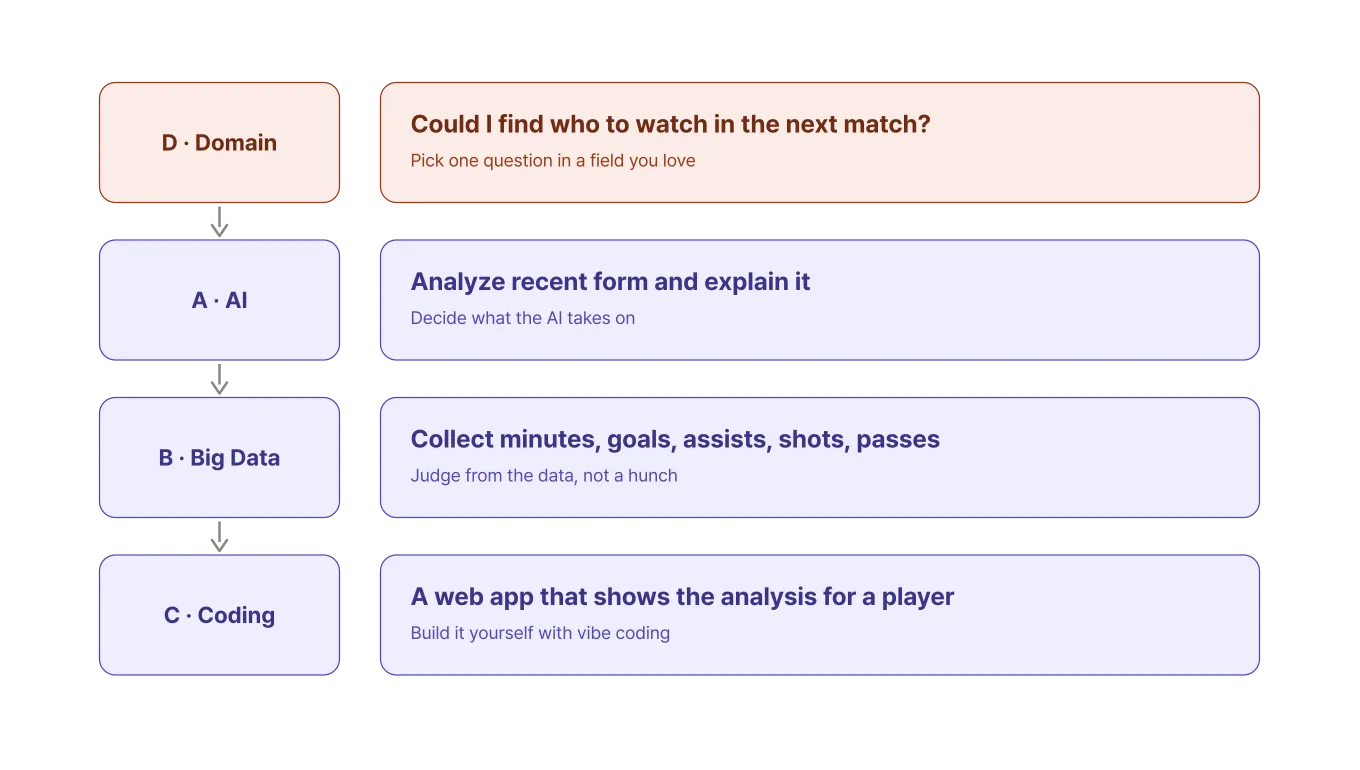
The ABCD framework we use in class starts from exactly that thought.
D · Domain — find a problem in a field you care about
A · AI — work out how AI could help solve it
B · Big Data — collect and analyze data to check the idea
C · Coding — build a real product with vibe coding
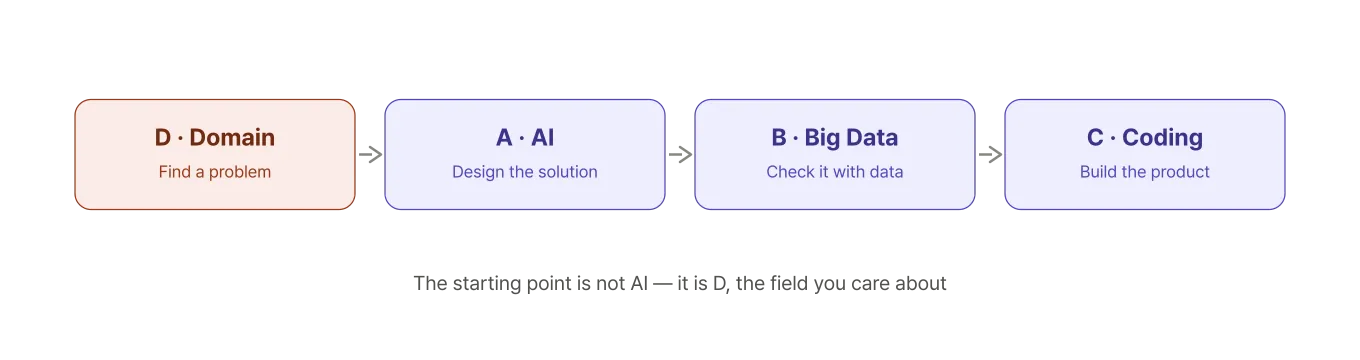
The most important part of ABCD may not actually be the AI.
It is the Domain that comes first.
You don’t force a problem into existence in order to learn AI.
You use AI, data, and coding to solve a problem you already cared about.
What would it look like for a student who loves soccer?
Imagine a student who really loves soccer.
They don’t know yet whether they want to be a developer,
a data scientist,
or a product manager.
But they do have a field they love.
Soccer.
So they can start from soccer.
D · Domain
Watching a match, they notice a question.
“Could I use players’ recent match data to find who to watch in the next game?”
First you settle on a problem you want to solve inside a field you care about.
A · AI
Next, think about what role AI could play.
You could analyze a player’s form from their recent record,
and have AI explain who is worth keeping an eye on next match.
B · Big Data
You collect data on minutes played, goals, assists, shots, passes, opponents, and more.
Then you check for yourself which of that data actually relates to performance.
Instead of vaguely thinking
“This player looks like he’ll do well.”
you judge from evidence.
C · Coding
Finally, you use vibe coding to build a simple web service that shows the match data and the AI’s analysis when you pick a player.
One project is finished.
But the finished website is not the important part of what happened.
Working through the project, the student gradually finds out what kind of work they enjoy.
“Analyzing the data was the best part for me.”
If that’s the feeling, data science and other data roles are worth exploring further.
“I liked building the actual features.”
Then AI engineering or software development may start to look interesting.
“Deciding which features to build was the most fun.”
Then AI product management may be a good fit.
Or the opposite:
“Studying soccer itself is more interesting to me than the AI.”
That is an important discovery too.
They have found their Domain.
Before settling on a career, try a small piece of the work
Career education usually explains the jobs first.
An AI engineer does this,
a data scientist does that,
a product manager does this other thing.
That information is necessary too, of course.
But it is hard to work out which work fits you from an explanation alone.
You have to analyze data yourself to find out whether data analysis is interesting.
You have to build a service yourself to find out whether development is interesting.
You have to look for a problem yourself to find out whether you like planning.
So in career exploration for the AI era,
“Which jobs are promising?”
matters about as much as
“What kind of problem-solving do I actually enjoy?”
If you like coding,
Coding × AI
If you like data,
Data × AI
If you like design,
Design × AI
If sports is your thing,
Sports × AI
If you care about environmental problems,
Environment × AI
If life science is interesting,
Biology × AI
You can build your own combination like that.
It is fine if your dream isn’t clear yet.
You can choose a career first and then build up experience,
but you can also try a range of things first and find your own path inside them.
The question students need in the AI era may not be
“Which job is going to take off?”
Before that, there is another one worth asking.
“Which field am I drawn to, and how could I solve a problem there with AI?”
Before choosing a career, try a small project on the future work you might do, inside a field you already like.
We think that is a good place to start preparing for the AI era.
Sources
- PwC, 2026 Global AI Jobs Barometer: Global findings, p. 9 (June 2026) — 68.9% and 8.6%
- U.S. Bureau of Labor Statistics, Artificial intelligence, information technology, and employment, 2024–34 (The Economics Daily, July 16, 2026) — 33.5% and 28.5%
- U.S. Bureau of Labor Statistics, Employment Projections — 2024–34 (news release USDL-25-1324, August 28, 2025)
- World Economic Forum, Future of Jobs Report 2025 (January 8, 2025) — 22% and 39%
- LinkedIn Economic Graph Research Institute, Labor Market Report: Building a Future of Work That Works (January 2026) — 70% AI literacy
- AI careers
- career education
- AI engineer
- data scientist
- ABCD framework